Project documentation // R&D division
SKW-RD-006
STÁLHRÍÐ
Skalds rarely called a fight a fight. They called it the storm of steel, stálhríð, the weather that blades make. I wanted a name for a machine that has to hold dead still, then move faster than the thing it's watching. It lives in that weather.
A precision pan/tilt platform built from quasi-direct-drive actuators, flat plate, and a CAN-FD bus. Step A toward a ground vehicle and a drone flock that work as one system.
- Designation
- SKW-RD-006
- Version
- rev 4
- Platform
- 2× CubeMars AKE60-8 · 2× mjbots moteus-c1 · CAN-FD · Jetson AGX Orin · 6S
- Status
- Configured · plates inbound
- Line
- SKALD Motion
01 · The Problem
I’d never owned the whole chain from a sensor to an output shaft. I wanted one machine where every stage, from the sensor to the output shaft, is mine to get wrong.
It’s also the first piece of something bigger. I’m building toward a rover, HILDIGRÍSS, and a drone flock, HRAFNAR, that work as one system. Both need a head that can find something and hold on to it. That head is STÁLHRÍÐ.
02 · The Solution
Built entirely from parts a hobbyist can order: no machined parts, no tapped holes, no custom electronics.
- Actuation: two CubeMars AKE60-8 quasi-direct-drive actuators (8:1), each run by an mjbots moteus-c1 controller.
- Pan: rides on an IKO crossed-roller ring, so the ring carries the platform loads and the actuator only supplies torque.
- Tilt: direct drive, with the far side on a shaft in a flanged bearing.
- Structure: thirteen plate designs in 6061, laser cut. Skeletonized motor cages on standoffs.
- Brain: an NVIDIA Jetson AGX Orin talks to both controllers over a single CAN-FD bus.
- Power: 6S, straight into the controllers. No buck converter in the motor feed: the controllers push braking current back into the bus, and a buck can’t absorb it.
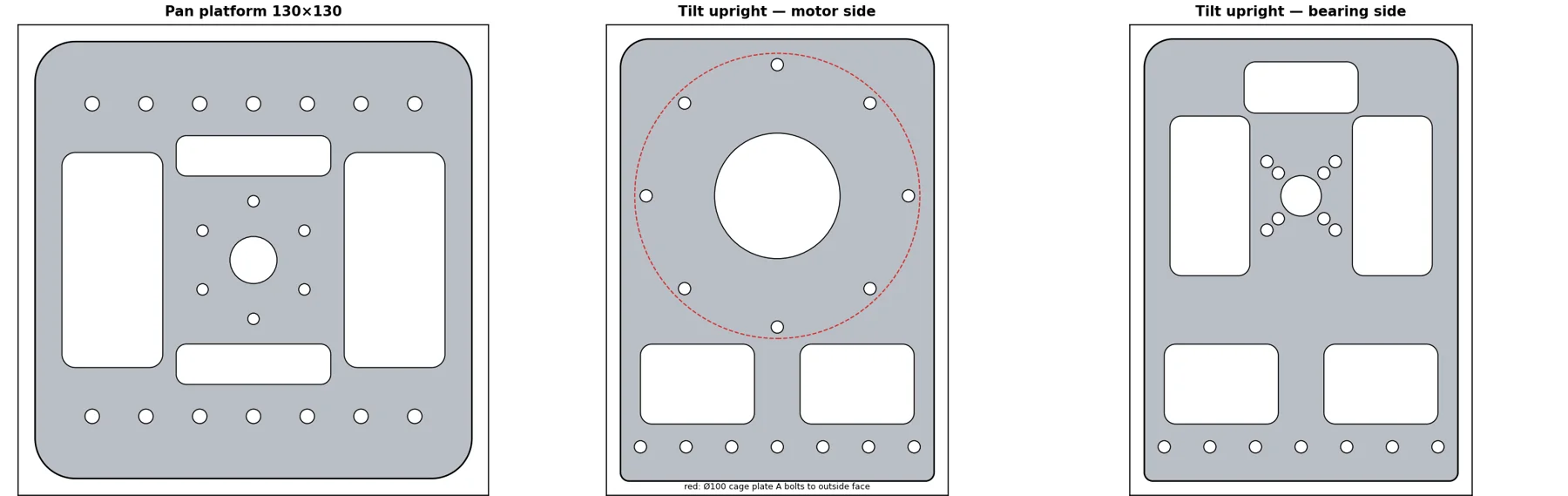 FIG 1 · Flat-plate design: the pan platform and both tilt uprights. Every part is a DXF, and a change costs an edit and a few dollars. (Earlier 2.5 mm revision shown; the build is 3.2 mm.)
03 · The Workflow — Bench to Track
Five stages, and each one ends on something I can check:
- Dry stack: every plate and fastener on the bench, unpowered.
- Bring-up: controllers configured, IDs set, limits set, verified by readback.
- Home: the encoder sits behind an 8:1 reduction, so output position is ambiguous at power-up. Homing settles it.
- Track: hold a target and follow it.
- Fuse: radar and camera agree on what’s worth following.
04 · The Hook — Find It, Then Hold It
The plan is a 60 GHz radar for finding things and a camera for confirming them. Each track gets its own Kalman filter, with gating, association, and tracks that are born and die. The Orin turns the chosen track into pan and tilt angles with velocity feed-forward, so the platform leads a moving target instead of lagging it.
05 · What Saves Time
- Bought actuation, not built. Two complete actuators with controllers, so I’m not building a third motor controller just to point something.
- Flat plate, no tapping. A design change costs a DXF edit.
- Paper first. Re-stacking every height for the thicker plate found three faults before metal arrived: a screw that would sweep into a flange head, one that would reach the rotor, and outer-ring heads clipping the spinning platform by 0.65 mm.
06 · The Result — And a Detour
Both controllers are configured, backed up, and answering on the bus. The plates arrive the week of October 19. Nothing has moved under power yet, so every number here is a target.
While it was still on the bench, my daughter took one look at it and asked whether it could help her win at foam-dart target shooting, because she keeps losing to her sibling. I loved that. So for a while this platform’s first job is a backyard target range, with an arm switch and an e-stop that don’t trust the computer. It turns out “hold dead still, then move fast” is exactly what a kid who wants to win needs too.
07 · Future Work
- Homing, calibration, and an independent arm switch / e-stop.
- Radar plus camera tracking.
- Onto a rover, where the head has to cancel out the vehicle’s own motion.
- Pairing with the drone flock: the drones search wide, and this confirms and tracks. That’s an idea, not a design yet.
Find it, hold it, never lose it. Step A.